


SP 500 Forecast SPX pulls back from the 7000 level ahead of inflation data
As the week draws to a close, the SPX index has so far failed to maintain a confident short-term outlook. In the current session, the index is down more than 1%, reinforcing a more consistent weakening scenario as markets await the release of annual U.S. inflation.
Written by
Julian Pineda
Market Analyst
As the week draws to a close, the SPX index has so far failed to maintain a confident short-term outlook. In the current session, the index is down more than 1%, reinforcing a more consistent weakening scenario as markets await the release of annual U.S. inflation (CPI) data tomorrow and assess how it could impact expectations for future Federal Reserve decisions.
Additionally, long-term confidence indicators have lacked stability, contributing to the persistent weakness seen in recent price action. Once markets digest the upcoming economic data, a clearer directional move could begin to take shape in the coming sessions.
The market awaits CPI data
Annual U.S. CPI data will be released tomorrow. Current forecasts point to inflation at 2.5%, down from the previous 2.7% reading. However, markets are not fully convinced that a sustained slowdown in price pressures is underway. This skepticism stems partly from the recent upside surprise in employment data (NFP), as well as the absence of a clear deceleration in inflation readings for November and December 2025, which have yet to show convincing convergence toward the Federal Reserve’s 2.00% target.

Source: TradingEconomics
This context is important because, following the employment data release, the probability of the Federal Reserve holding rates at 3.75% rose above 93%, compared to roughly 70% just one month ago. This shift suggests that the strong labor market performance has led markets to adjust expectations, anticipating a firmer stance from the Fed in the near term.
Under this scenario, if inflation fails to show clear signs of cooling, it could reinforce expectations that interest rates will remain elevated for longer in order to contain price pressures.
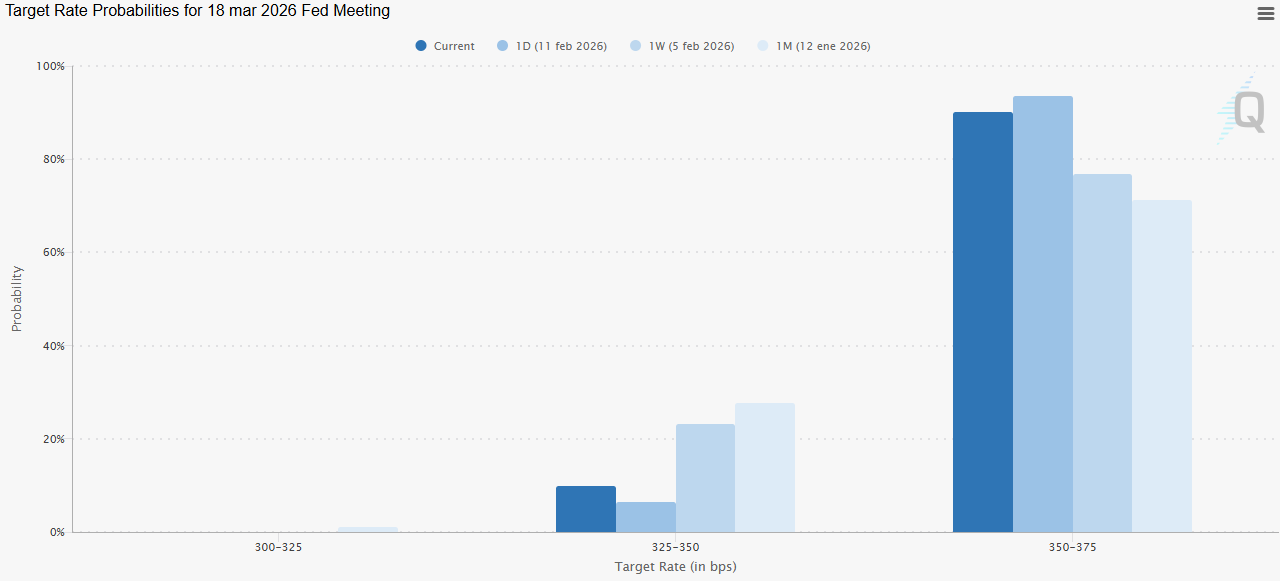
Source: CMEGROUP
In this environment, expectations surrounding economic data are weighing on equity market confidence. A scenario in which employment strengthens but inflation does not ease convincingly reduces the likelihood of rapid rate cuts. This implies higher borrowing costs for longer, slower consumer momentum, and potential pressure on corporate growth—factors that ultimately reduce the appeal of instruments such as the SPX.
Thus, the index’s recent weakness reflects market indecision ahead of the inflation release and uncertainty about the path of prices in the coming months. If the data surprise to the upside, expectations of higher rates for longer could strengthen, weighing on equity appetite. Conversely, a clear and sustained slowdown in inflation could help restore confidence in the short term.
Long-term confidence remains in sensitive territory
Beyond short-term economic expectations, long-term sentiment in the equity market remains uncertain. According to the AAII Investor Sentiment Survey, the six-month outlook shows 38.5% bullish, 23.3% neutral, and 38.1% bearish, highlighting the absence of a dominant directional bias in market expectations.
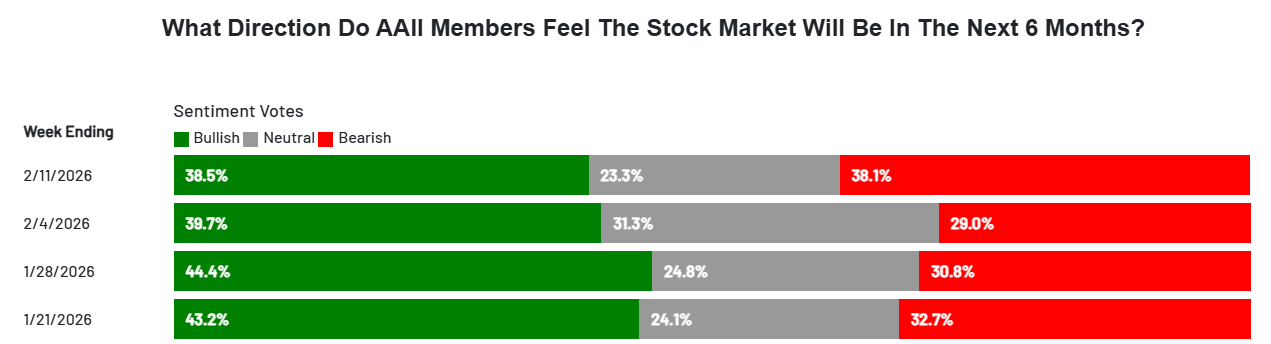
Source: AAII
If the AAII confidence index fails to show sustained improvement in the coming weeks, this could limit the stability of long-term demand for indices such as the SPX. As a result, structural confidence may become an additional factor preventing a consistent recovery in buying pressure.
S&P 500 technical Outlook
Source: StoneX, Tradingview
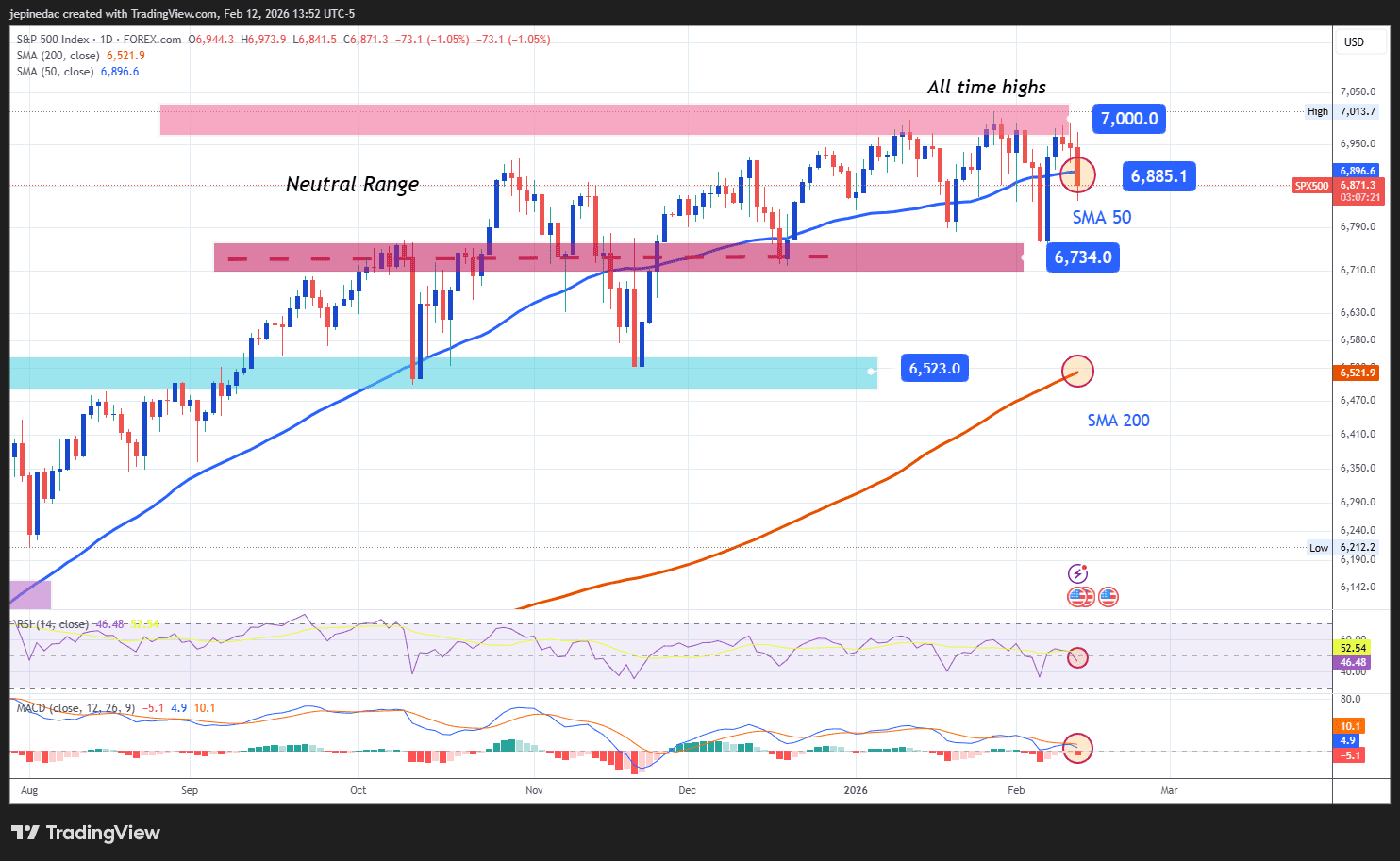
- Dominant sideways range: Since November 2025, the SPX has maintained a sideways structure, fluctuating between resistance near 7,000 points and support around 6,700 points. So far, neither bullish nor bearish momentum has been strong enough to break this range, which remains the most relevant technical formation. As long as this structure holds, the emergence of a more dominant directional trend could remain limited.
- RSI: The RSI line remains near the neutral 50 level, indicating that bullish and bearish momentum over the past 14 sessions is balanced. This behavior reflects ongoing indecision in recent SPX price action.
- MACD: A similar scenario is visible in the MACD, where the histogram remains close to the zero line, suggesting that short-term moving average momentum is neutral. This reinforces the perception of near-term indecision.
Key levels:
- 7,000 points – Key resistance: A level aligned with historical highs and representing an important psychological barrier. A sustained break above this area could reactivate a stronger bullish bias.
- 6,885 points – Near-term barrier: A neutrality zone aligned with the 50-period simple moving average. Prolonged price action around this level could maintain the current sideways range.
- 6,734 points – Key support: The level defining the floor of the current trading range. Sustained declines below this zone could trigger more dominant selling pressure in the coming weeks.
Written by Julian Pineda, CFA, CMT – Market Analyst
Follow him on: @julianpineda25
Related tags:
Latest market news











Web Trader platform
Our sophisticated web-based platform is packed with features.
Open an account today
Experience award-winning platforms with fast and secure execution.
Economic calendar
Related articles

Gold and S&P 500 analysis: What now after Warsh’s hawkish speech?
The dollar surged across the board after the Fed Chair Kevin Warsh surprised with a hawkish-leaning speech at the Jackson Hole summit. All the bearish dollar bets that had been accumulated since last Friday on the back of data weakness and bond market troubles had to be squared and that triggered a short squeeze rally for the dollar. Gold and silver dropped, as a result, as too did bitcoin, while US indices were giving back earlier gains.


S&P 500 Forecast: SPX after Nvidia revives confidence in the AI trade
U.S. stocks are heading higher on Thursday, with technology leading the move after Nvidia's stronger-than-expected outlook revived confidence in the AI trade.

DAX and EUR/USD forecast: Lower energy prices, yields offer support
But the question, of course, is how much further oil prices and bond yields can fall. For now, the combination is supportive of risk assets and is helping to sustain a relatively benign decline in the dollar. The focus today will be on US core PCE inflation, due for release shortly, while Nvidia’s second-quarter earnings will provide another test for risk appetite after the US markets close – not just for US indices but for global tech-heavy indices given the influence Nvidia has over the global tech and AI names.