Dollar to reflect Brazilian electoral scenario, Copom minutes, RPM, IPCA-15, and expectations of higher interest rates in the US
- Bullish
- The expectation of higher interest rates for a longer time in the US should increase the yield on US Treasuries and favor the attraction of foreign capital to the country, strengthening the USD globally.
- Bearish
- The strengthening perception of a more balanced electoral race, by increasing the possibility of government change and a more conservative fiscal approach, may reduce the risk premium of domestic assets and favor the BRL.
- The release of the Copom minutes, Monetary Policy Report, and IPCA-15 should reinforce the perception of inflationary risks and strengthen the reading of an interruption in the Selic rate cut cycle, increasing bets on maintaining domestic bond yields and favoring the performance of the BRL.
The week in review
- Last week was marked by the “super Wednesday,” when monetary authorities from the US and Brazil held their interest rate decision meetings on the same day.
- In the US, the Federal Open Market Committee (FOMC) raised the federal funds rate range from 3.50% - 3.75% to 3.75% - 4.00% per year.
- Meanwhile, in Brazil, the Monetary Policy Committee (Copom) reduced the basic interest rate (Selic) by 0.25 percentage points, from 14.00% to 13.75% per year, reducing the interest rate differential between the countries.
- Despite the smaller interest rate differential, the exchange rate remained relatively stable, as the decisions were largely anticipated and due to the greater sensitivity of the exchange rate to electoral news in recent weeks.
USDBRL and Dollar Index (points)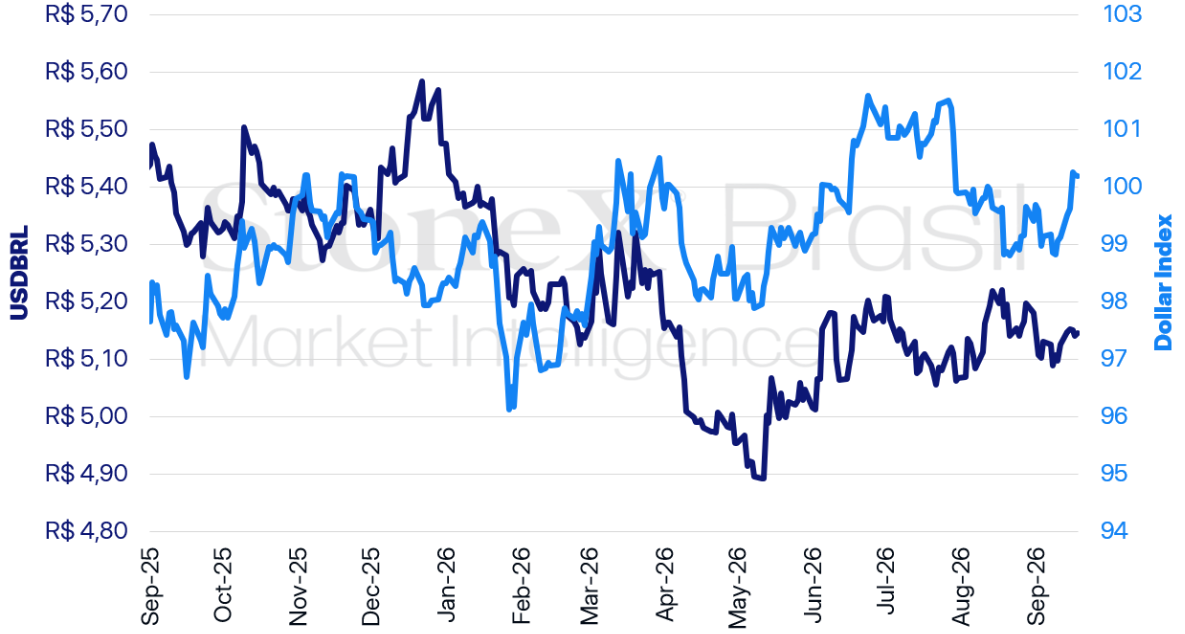
Source: StoneX cmdtyView. Design: StoneX.
USDBRL variations | Daily: -0.18% | Weekly: +0.32% | Monthly: -0.77% | Yearly: -6.12% | In 12 months: -3.02%
Dollar index variations | Daily: -0.05% | Weekly: +1.08% | Monthly: +0.79% | Yearly: +1.91% | In 12 months: +3.35%
KEY EVENT: Brazilian electoral race
Expected impact on the USDBRL: bearish
Investors should react to the presidential election intention polls, calibrating their expectations for the election results and economic policy management over the next four years.
- During the week, three intention polls will be released: Quaest and BTG Pactual/Nexus polls on Monday (21) and the AtlasIntel poll on Wednesday (23).
- Financial market operators will seek to measure in these polls potential impacts of recent developments involving Banco Master, the institutional crisis in the Supreme Federal Court (STF), and the increase in the Bolsa Família benefit by the federal government.
Why this matters: A tight electoral race could reduce predictability regarding Brazilian economic policies for the next four years, increasing the perception of risks for domestic assets, amplifying volatility, and harming the performance of the Brazilian real.
- In particular, recent reactions from financial market agents reveal a preference for the election of a new president, who could be more conservative in fiscal policy.
- Therefore, a higher likelihood of government change tends to reduce the risk perception of domestic assets and favor the performance of the BRL.
Recent polls: Last Thursday (17), Datafolha revealed that intentions to vote for president in a potential second round remained stable, with 46% of the intentions for Lula and 44% for Flavio Bolsonaro.
- In the AtlasIntel poll released the same day, Flavio Bolsonaro and Lula registered 47.2% and 46.8% of the intentions, respectively.
- Although still in a technical tie, Flavio’s numerical advantage over Lula went from 0.2 p.p. in the previous poll to 0.4 p.p., suggesting continued progress for Flavio.
Tight elections: Despite the divergence in trends indicated by the polls, the results suggest a highly competitive race, with no statistically significant advantage for either candidate.
- Given the disputed scenario, monitoring intention polls should gain even more relevance, especially given the recent political news, which could impact the election results.
- Additionally, the narrow margins between candidates tend to favor greater volatility in trading sessions as candidates move closer or further apart in the polls.
Higher US interest rates for longer
Expected impact on the USDBRL: bullish
US: History and expectation for interest rates – updated on September 18, 2026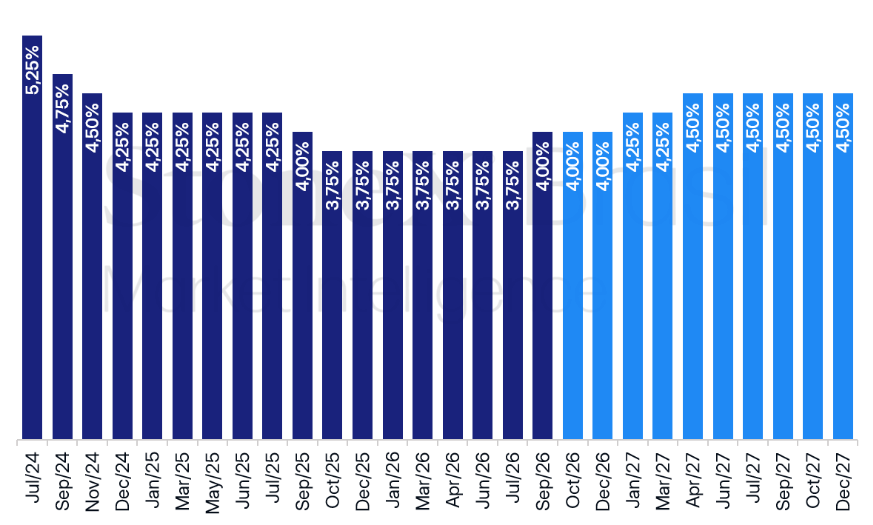
Source: CME FedWatch Tool. Design: StoneX. Refers to the market's most probable bet on interest rates as of the indicated date.
Expectation for the US interest rate at the end of 2026 (% p.a.)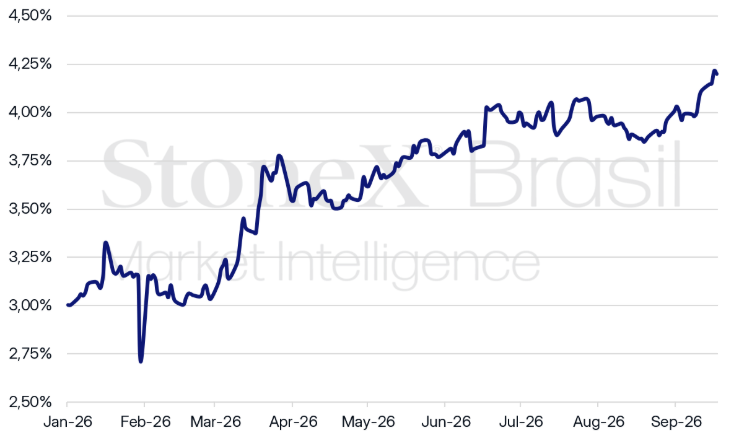
Source: Bloomberg. Design: StoneX.
Investors should also react to the expectation of higher interest rates for longer in the United States, after the Federal Reserve (Fed) suggested last week a firmer monetary tightening process.
- In this regard, the speeches of six Fed members scheduled for this week may contribute to calibrating investor expectations for US monetary policy.
Why this matters: The expectation of higher interest rates for longer in the US should increase yields on US Treasuries and favor the attraction of foreign capital to the country, strengthening the dollar globally.
FOMC raises rates: Last week, the Federal Reserve's Federal Open Market Committee (FOMC) raised US interest rates to the range between 3.75% and 4.00% p.a. to “support a quicker return [of inflation] to the 2% [annual] target.”
- Although the rate hike was widely anticipated, the FOMC's stance was even firmer than expected and reinforced expectations of higher interest rates for longer in the US.
Firm stance against inflation: The following factors contributed to this perception of firmness:
- The FOMC decision was unanimous, with no votes to maintain interest rates;
- The Committee's Summary Economic Projections showed a clearly asymmetric risk balance tilted toward inflationary risks, forecasting more economic growth, lower unemployment rates, and higher inflation.
- Additionally, 16 out of 18 members participating in the projections anticipated at least one more rate hike in 2026, with the median also pointing to higher rates in 2026, 2027, and 2028 compared to June projections.
- In the press conference, Fed Chairman Kevin Warsh suggested that this is the beginning of a rate hike cycle, stating that the Committee “removed a dose of accommodation” (not all the accommodation provided by rates) and that the decision “starts to show we are serious” about restoring price stability.
Median of FOMC members' projections for US interest rates at the end of each year (% p.a.)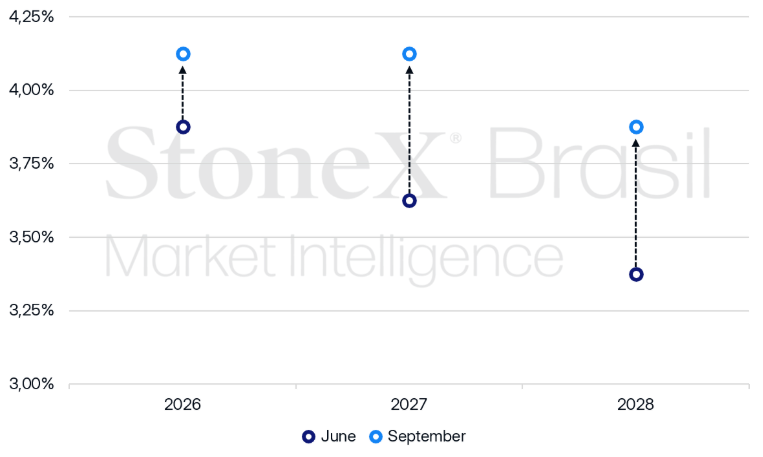
Source: Federal Reserve. Design: StoneX.
Less transparent Fed: The speeches of other FOMC members gain importance due to Kevin Warsh's cryptic communication style, as they provide analyses and discussions about the economic outlook that the Fed Chairman refuses to address.
- Little by little, Warsh is implementing changes to the Federal Reserve's communication style, making it more concise, generic, and less informative.
- Since the first rate decision after Warsh became Fed Chairman, the statement has become significantly shorter and more generic.
- Additionally, he refuses to discuss future scenarios or possible next steps for the Federal Reserve.
- In the July meeting, Warsh suggested to other FOMC members to reduce the number of Federal Reserve rate decisions from eight to six per year.
- In last week's decision, the Fed reformulated the press conference, reducing its duration to thirty minutes (the shortest in the institution's history), limiting each journalist to one question, and involving a broader range of media outlets but leaving out some specialized outlets, such as Reuters.
- Warsh is also a critic of the Summary Economic Projections and does not participate in them.
- For this reason, there is speculation that both the press conferences and the Projections may be modified or eliminated after December, the deadline for the Federal Reserve's task force to conclude its work on evaluating its communication approach.
Copom minutes, Monetary Policy Report, and IPCA-15
Expected impact on the USDBRL: bearish
Brazil: History and expectation for interest rates – Focus bulletin of September 11, 2026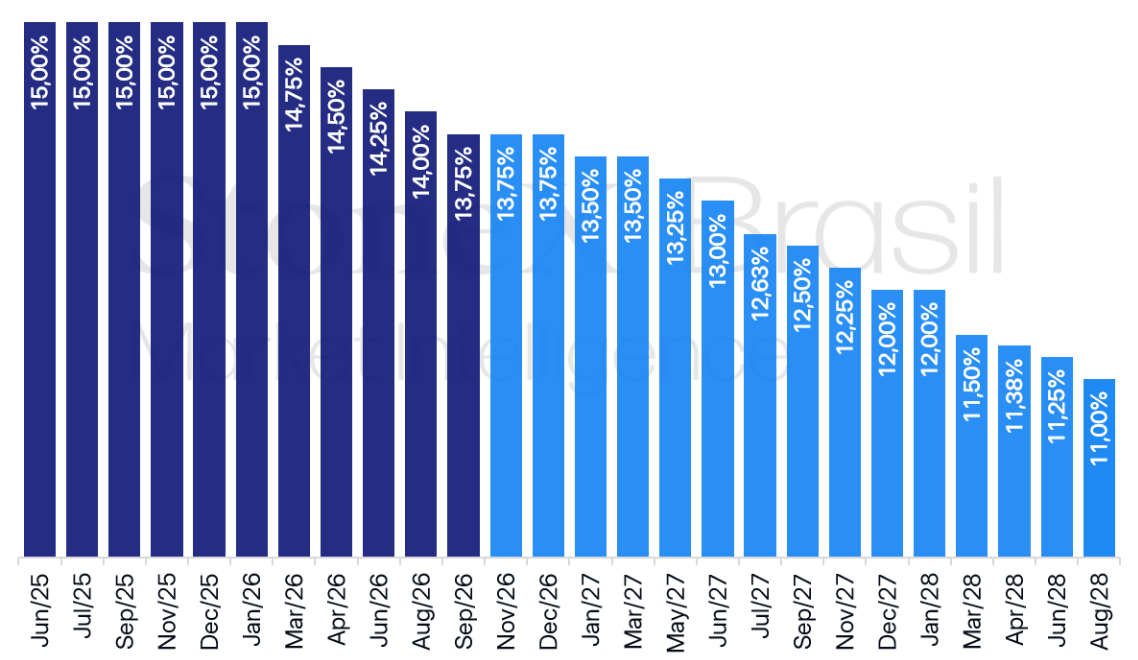
Source: Central Bank of Brazil. Design: StoneX.
Additionally, investors should react to the release of documents and indicators that could influence expectations for the management of monetary policy in Brazil.
- On Tuesday (22), the minutes of the last Monetary Policy Committee (Copom) meeting, where the basic interest rate (Selic) was reduced from 14.00% to 13.75% per year, will be released, likely deepening the risk balance for Brazilian inflation.
- On Thursday (24), the September Monetary Policy Report will be released, providing the Central Bank's most comprehensive analysis of the domestic and international macroeconomic environment and including projections for key Brazilian macroeconomic indicators for the coming years.
- Finally, on Friday (25), IBGE will release the September Broad Consumer Price Index 15 (IPCA-15).
Why this matters: The reports should indicate higher inflationary risks, which may reduce bets on new Selic rate cuts, favor domestic bond yields, and strengthen the BRL.
Neutral tone: Copom maintained its neutral tone in the statement issued after its rate decision, emphasizing serenity and caution in monetary policy management while monitoring the inflationary trajectory in the country.
- As such, future rate decisions should depend on upcoming economic indicators, especially inflationary ones.
Risk balance: Copom acknowledged a slowdown in inflation and economic activity, although the latter remains resilient while the labor market remains strong.
- On one hand, recent readings of price indices pointed to a slowdown in inflation, which has been within the target margins since July.
- On the other hand, the escalation of the Middle East conflict, keeping oil prices above US$100 per barrel, combined with the prospect of intense El Niño later this year, which typically harms agricultural harvests, keeps the monetary authority cautious.
- Moreover, the country's economic activity and labor market remain resilient, reinforcing risks of overheating demand and potential inflationary pressures.
IPCA-15: In the economic indicator agenda, investors should monitor the September IPCA-15 reading, which may reflect the reversal of some elements that favored the deflation recorded in the previous month.
- Housing costs are expected to rise with the end of the Itaipu bonus, while transportation costs may also increase, with airfare hikes offsetting the small drops in fuel prices.

INDICATORS
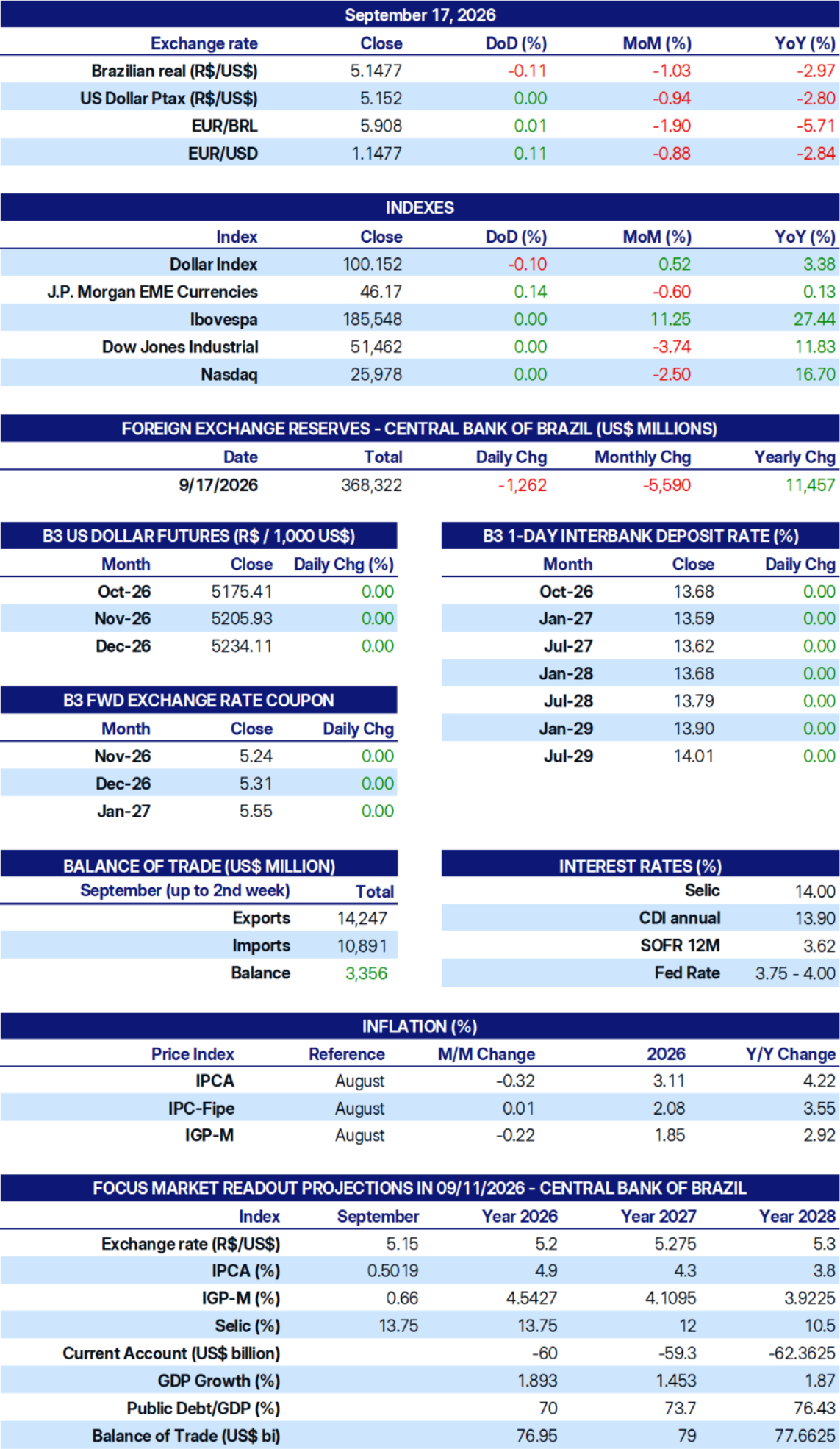
Sources: Central Bank of Brazil; B3; IBGE; Fipe; FGV; MDIC; IPEA, and StoneX cmdtyView.