


Crypto Fundamental Analysis: Restrictive Central Banks Limit Crypto Confidence
September continues to advance and a mixed environment remains evident across the cryptocurrency market, where short-term confidence has struggled to stabilize in a consistent manner. Part of this situation is linked to the latest inflation data released in the United States, which continues to reinforce the possibility of a more aggressive central bank environment over the coming months.
Written by
Julian Pineda
Market Analyst
September continues to advance and a mixed environment remains evident across the cryptocurrency market, where short-term confidence has struggled to stabilize in a consistent manner. Part of this situation is linked to the latest inflation data released in the United States, which continues to reinforce the possibility of a more aggressive central bank environment over the coming months. This backdrop could continue affecting risk-oriented assets such as cryptocurrencies and, as long as these concerns remain relevant, a growing phase of indecision may continue to characterize market activity in the weeks ahead.
Are More Aggressive Central Banks Returning?
This week has been especially important for assessing the direction of monetary policy among major central banks. The first major event came from the European Central Bank, which decided to raise its deposit rate to 2.5% while also leaving the door open to a more restrictive stance if inflationary pressure continues increasing in the months ahead.
In fact, following this week's decision, market probabilities continue to assign roughly a 61% chance of another rate increase toward 2.75% at the October 28 meeting. This situation reflects the fact that investors continue pricing in a more aggressive ECB over the coming months.
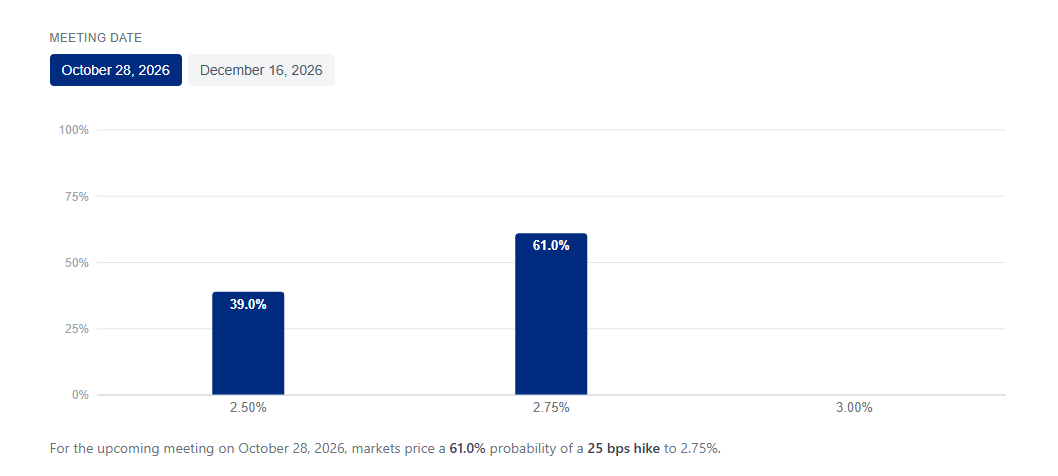
Source: ECBWATCH
The dynamic continued toward the end of the week with the release of U.S. CPI data. Annual inflation came in at 3.4%, in line with expectations, while Core CPI registered 2.4%, also matching market forecasts.
Although inflation did not surprise to the upside, the data also failed to show a meaningful reduction in underlying inflationary pressures. As a result, expectations for a more aggressive Federal Reserve continue to strengthen. This is already reflected in market probabilities, where there is now more than an 86% chance that interest rates will rise to 4.00% at the September 16 meeting, up from the current 3.75% level.
This situation is particularly relevant because it highlights that the possibility of more restrictive monetary policy is no longer limited to the ECB. Instead, it is beginning to spread across other major central banks around the world.
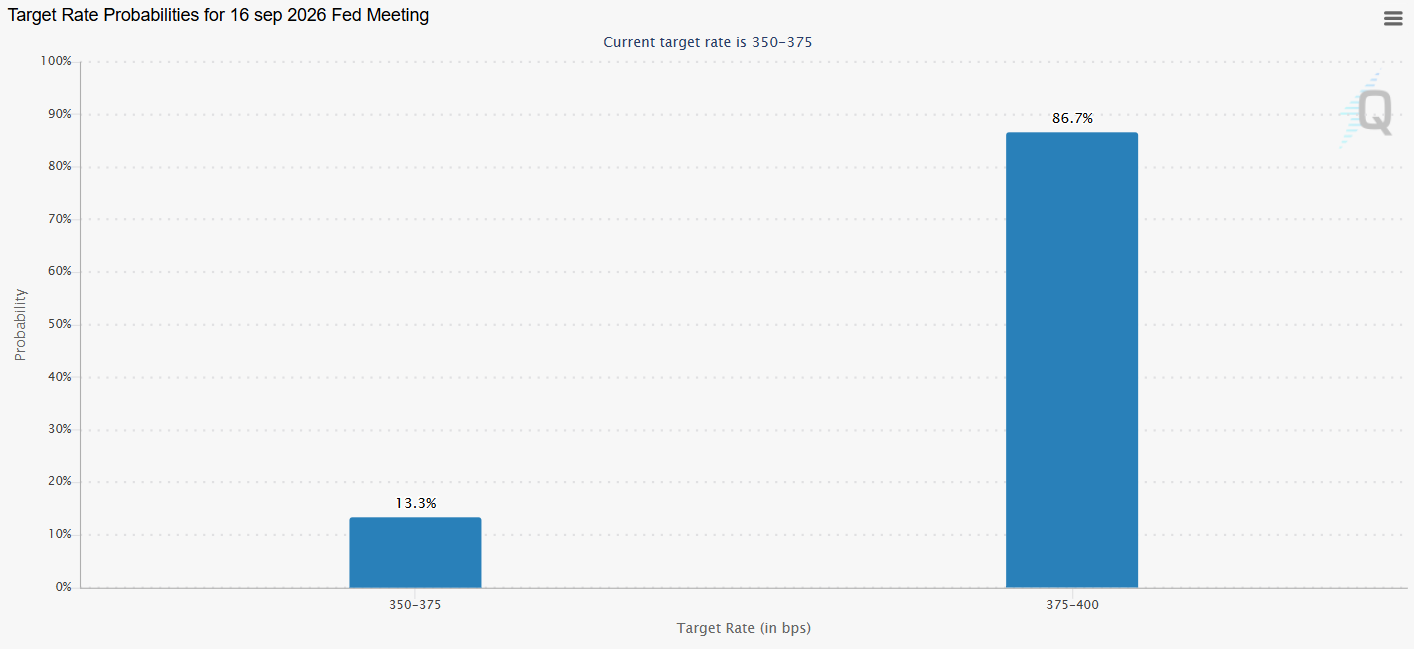
Source: CMEGROUP
This environment may become increasingly challenging for cryptocurrencies because higher interest rates maintained for a prolonged period generally increase the attractiveness of more stable markets while reducing part of the liquidity available for higher-risk assets.
As a result, expectations of more restrictive central banks could limit the crypto market's ability to establish a more consistent recovery over the medium term, particularly if uncertainty surrounding global monetary policy continues to increase.
Taking all of this into account, a more aggressive central bank environment could continue favoring assets such as the U.S. dollar and sovereign bonds, markets that often compete directly with cryptocurrencies for capital flows. As long as this backdrop remains in place, it could become more difficult for the crypto market to regain stronger confidence and a phase of indecision may continue to be an important feature of market activity over the coming weeks.
Bitcoin Versus Other Markets
Now, it is also important to monitor the increasing correlation between Bitcoin and traditional risk assets such as the S&P 500. Over the last 25 trading sessions, the correlation coefficient has moved back above the 0 level, reflecting a positive relationship between both markets and increasing similarity in their recent price movements. Correlation coefficients can change over time.
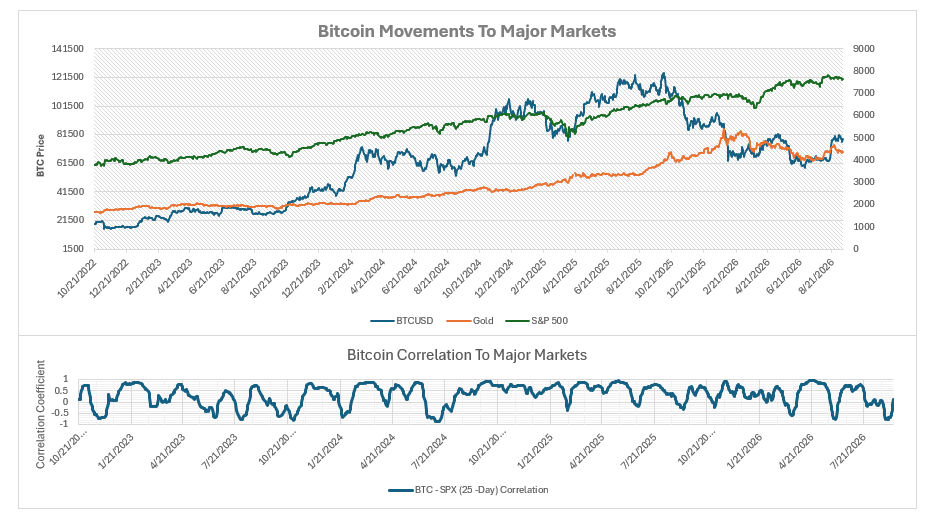
Source: Data – TVC, StoneX, Tradingview
This relationship is particularly important because it once again places Bitcoin within the broader dynamics typically observed across traditional risk assets. During recent sessions, markets such as the S&P 500 have also struggled to sustain a consistent recovery, a situation that may reflect a partial migration of capital toward more defensive markets.
As this correlation continues to increase, the slowdown in momentum observed across traditional markets could gradually begin affecting Bitcoin as well. This reinforces the view that factors such as expectations for more aggressive central banks are becoming increasingly important for cryptocurrency price action.
It is also worth noting that the cryptocurrency market has failed to produce particularly meaningful price movements during the week when compared with the variations observed over one-month, three-month, or annual time horizons. In this context, only Litecoin and Dogecoin have displayed more notable weekly performance, while the broader market continues to reflect an important degree of caution.
This situation suggests that although certain cryptocurrencies continue showing recovery potential, the market as a whole has yet to establish a stable and consistent level of demand confidence in the short term.
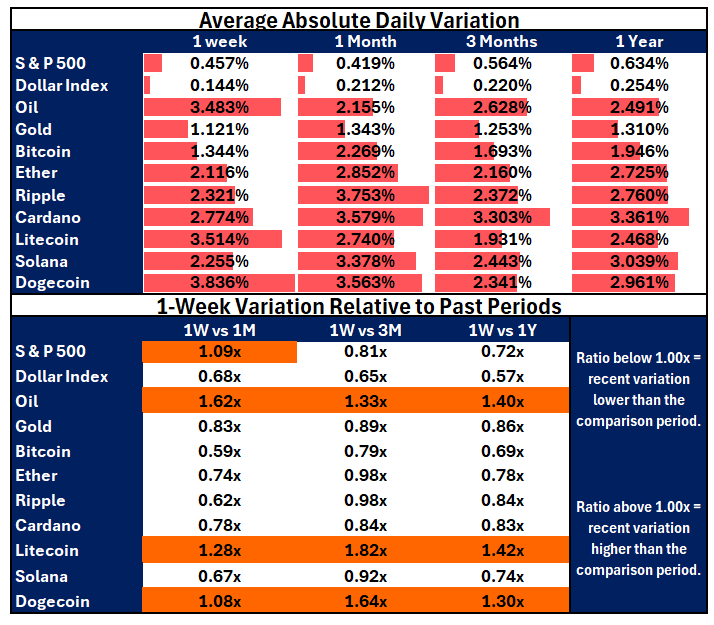
Source: Data – TVC, StoneX, Tradingview
Taking all of this into account, it remains important to recognize that as long as the cryptocurrency market continues displaying relatively limited price fluctuations and a growing correlation with traditional risk assets, confidence around demand may continue to face difficulties stabilizing. Unless stronger price moves begin to emerge or the market becomes less dependent on the dynamics affecting traditional risk assets, a phase of indecision could continue dominating a significant portion of crypto market activity in the weeks ahead.
Confidence Continues to Fade
Recent movements in the Fear & Greed Index continue to reflect a meaningful moderation in sentiment. The indicator is currently fluctuating around 69 points, remaining within the "Greed" zone but failing to advance back toward "Extreme Greed" territory. This behavior suggests that the confidence observed in previous weeks continues to lose momentum gradually.
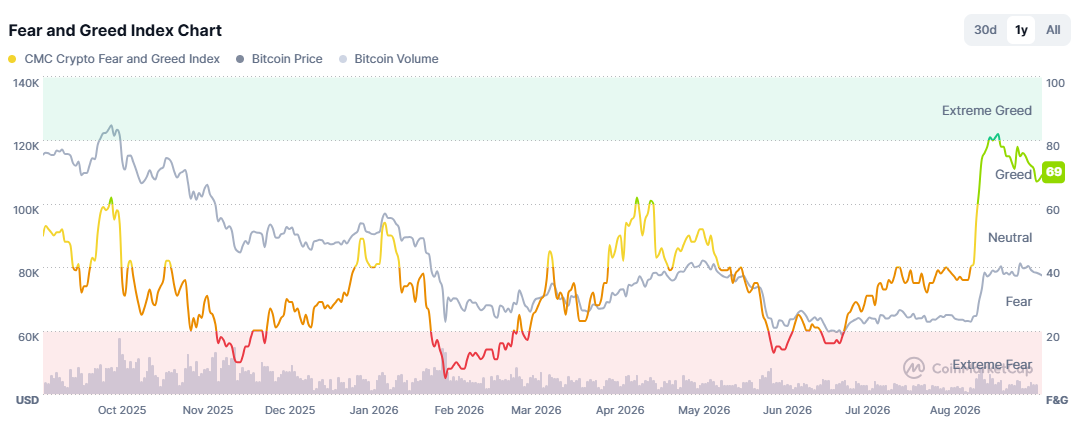
Source: Coinmarketcap
The evolution of this indicator remains important because it often serves as a barometer of risk appetite within the cryptocurrency market. Although current levels still reflect optimism, the recent decline suggests that part of the enthusiasm observed in earlier weeks continues to moderate.
If this trend persists over the coming sessions, it could reinforce the sense of caution that began emerging alongside expectations of more aggressive central banks and make it more difficult for the crypto market to establish a more stable demand environment.
Under that scenario, the lack of direction could remain one of the most important factors to monitor over the coming weeks.
Written by Julian Pineda, CFA, CMT – Market Analyst
Follow Him: @julianpineda25
Latest market news











Web Trader platform
Our sophisticated web-based platform is packed with features.
Open an account today
Experience award-winning platforms with fast and secure execution.
Economic calendar
Related articles

Bitcoin Forecast: BTC/USD Back to $80K Ahead of Warsh’s Jackson Hole Speech
After surging over $15,000 in the past 10 days alone, there is risk of a near-term pullback if Warsh says anything remotely hawkish at Jackson Hole - what are the levels to watch from here?


Bitcoin, Gold Price Outlook: US CPI & Overbought Risks in Focus
Bitcoin, Gold Price Outlook Following a steep risk-on rally across US equity indices and precious metals, several major markets are approaching critical technical levels as momentum becomes increasingly stretched.


Bitcoin, Dow Jones Outlook: Dow Tests Major Resistance and Bitcoin Lags Below $67,000
Bitcoin, Dow Jones Outlook: Bitcoin remains below $67,000 while the Dow Jones tests major multi-year resistance. Key technical levels that could determine the next market move.