


Canadian Dollar Forecast: USD/CAD Traders Weigh Hot CPI vs. Tariff Risk
Canada’s July CPI rose 3.0%, up from 2.8% in June, though median CPI was more moderate at 2.0% ahead of Wednesday deadline for 50% tariffs on $20B of Canadian exports to the US - what are the implications for USD/CAD?
Written by
Matt Weller
Head of Market Research
USD/CAD Key Takeaways
- Canada’s July CPI rose 3.0%, up from 2.8% in June, though median CPI was more moderate at 2.0%.
- The US has threatened 50% tariffs on roughly $20 billion of Canadian imports, raising risks ahead of Wednesday’s deadline.
- USD/CAD’s medium-term bias continues to point lower, so traders will likely look to sell any short-term rallies
After a week of North American traders focusing on the developments in the US (CPI, PPI, Retail Sales), the focus this week shifts north of the 49th parallel.
“Canada Week” started with this morning’s July CPI report, which came in slightly hotter than expected with headline CPI rising 3.0% y/y from 2.8% in June. The increase was largely driven by gasoline, which jumped 25.7%, along with higher travel costs around the World Cup festivities. Underlying inflation was calmer, with Trimmed CPI at 1.9% and Median CPI at 2.0%. This combination suggests the headline increase is still concentrated rather than evidence of a broad resurgence in price pressures.
Attention now turns to Wednesday’s tariff deadline. The US has threatened 50% tariffs on roughly $20 billion of Canadian imports, with USMCA-compliant goods no longer automatically exempt under the proposed measures. Canadian and US officials remain in intense negotiations ahead of the deadline, though reports suggest the two sides are still far apart from a comprehensive agreement. Instead, an interim arrangement or deadline suspension may be the best that the two sides could hope for this week.
For the Bank of Canada, the combination of inflation and tariff uncertainty argues for patience. Core inflation remains close to the 2% target, while additional tariffs could weaken Canadian growth but also create new price pressures. That leaves the BOC facing risks on both sides and supports keeping the policy rate at 2.25% at the September 2 meeting unless the trade outlook changes materially. Further out, traders are pricing in 70% odds of another BOC rate hike this year, lending some strength to the Canadian dollar.
Canadian Dollar Technical Analysis: USD/CAD Daily Chart
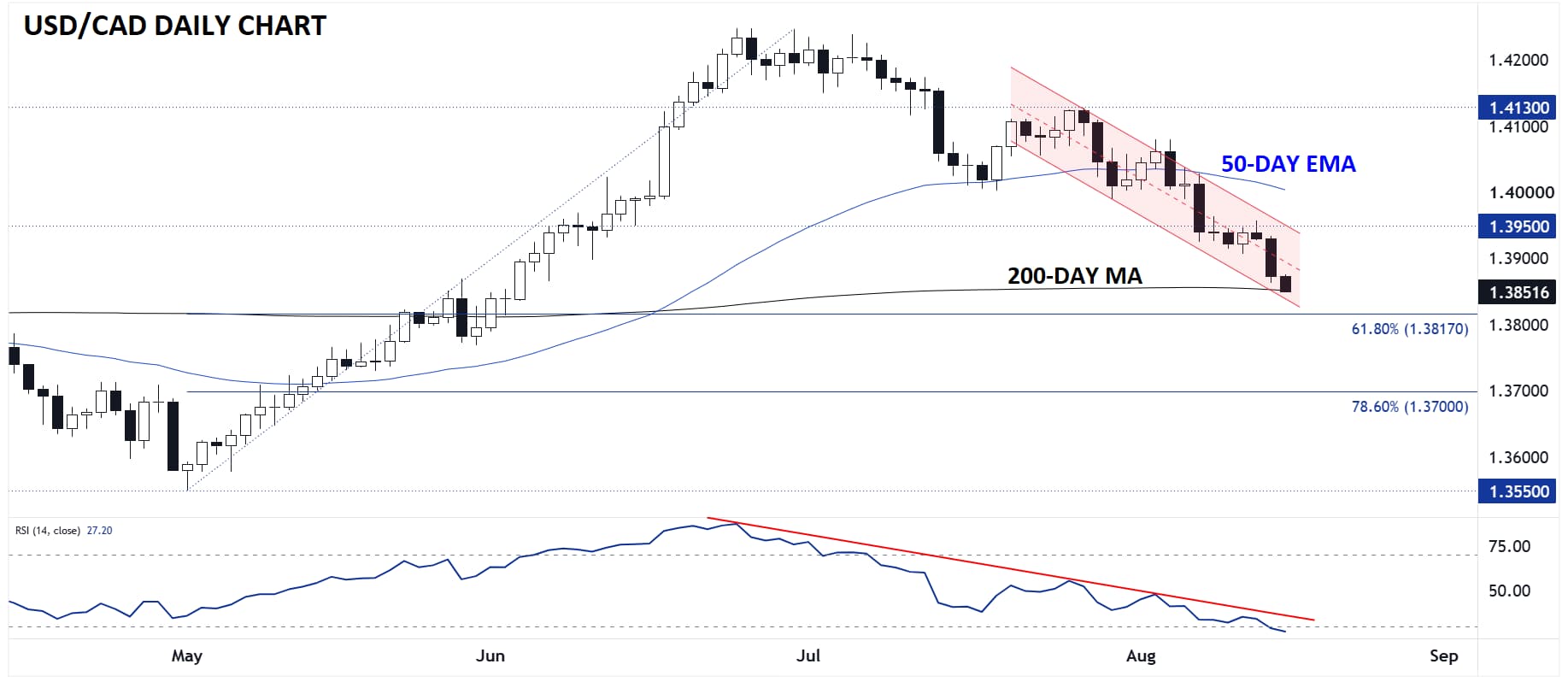
Source: Tradingview, StoneX
Looking at the chart of USD/CAD, the pair remains within its 1-month bearish channel, falling to test the flat 200-day MA near 1.3850 as we go to press. Between lingering tariff uncertainty and combined support in the mid-/lower-1.3800s, a near-term bounce is a distinct possibility.
That said, the medium-term bias continues to point lower, so traders will likely look to sell any short-term rallies as long as the pair remains within its bearish channel and the 14-day RSI stays below its bearish trend line.
-- Written by Matt Weller, Global Head of Research
Check out Matt’s Daily Market Update videos on YouTube and be sure to follow Matt on Twitter: @MWellerFX
Latest market news











Web Trader platform
Our sophisticated web-based platform is packed with features.
Open an account today
Experience award-winning platforms with fast and secure execution.
Economic calendar
Related articles

EUR/USD forecast: All eyes on Warsh at Jackson Hole - Forex Friday
For much of this week, the EUR/USD has been edging lower with the US dollar regaining some ground after last week’s sell-off that was triggered, in part, by the bond market worries. Investors have been unwilling to bet further against the US dollar so far this week ahead of Kevin Warsh’s keynote speech at the Jackson Hole summit, due later today.


Bitcoin Forecast: BTC/USD Back to $80K Ahead of Warsh’s Jackson Hole Speech
After surging over $15,000 in the past 10 days alone, there is risk of a near-term pullback if Warsh says anything remotely hawkish at Jackson Hole - what are the levels to watch from here?

DAX and EUR/USD forecast: Lower energy prices, yields offer support
But the question, of course, is how much further oil prices and bond yields can fall. For now, the combination is supportive of risk assets and is helping to sustain a relatively benign decline in the dollar. The focus today will be on US core PCE inflation, due for release shortly, while Nvidia’s second-quarter earnings will provide another test for risk appetite after the US markets close – not just for US indices but for global tech-heavy indices given the influence Nvidia has over the global tech and AI names.